Introduction
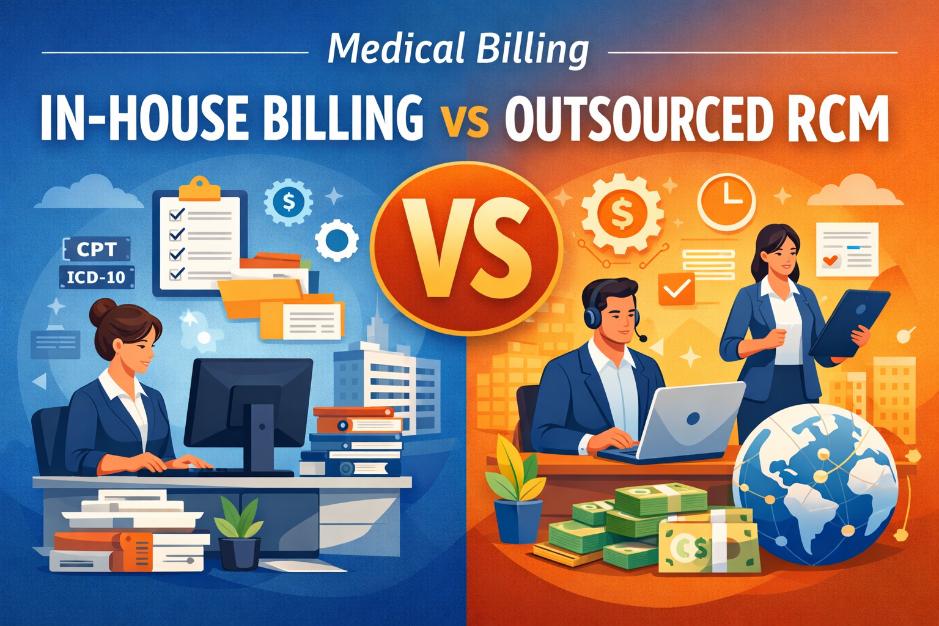
Healthcare providers face a critical decision when managing their revenue cycle: handle medical billing in-house or outsource it to a professional Revenue Cycle Management (RCM) company. Both approaches have advantages and challenges, and the right choice depends on a practice’s size, resources, and long-term goals. This blog compares medical billing RCM vs in-house billing to help you decide which option is best for your practice.
What Is In-House Medical Billing?
In-house billing means managing the entire revenue cycle internally using practice staff and billing software. The team handles coding, claim submission, follow-ups, denial management, and patient billing.
Key Characteristics:
- Full internal control
- Dedicated in-office billing staff
- Practice-managed software and compliance
What Is Outsourced Medical Billing RCM?
Outsourced RCM involves partnering with a third-party medical billing company that manages all or part of the billing process. These companies use specialized tools and trained professionals to optimize reimbursements.
Key Characteristics:
- Access to billing and coding experts
- Advanced RCM technology
- Scalable services
Comparing In-House Billing and Outsourced RCM
1. Cost Efficiency
In-House Billing:
Requires salaries, benefits, training, software licenses, and compliance costs. Expenses increase as the practice grows.
Outsourced RCM:
Usually operates on a percentage-based or flat-fee model, reducing overhead and eliminating staffing and training costs.
Winner: Outsourced RCM
2. Expertise and Accuracy
In-House Billing:
Staff knowledge may be limited, especially with frequent coding and regulatory changes.
Outsourced RCM:
Employs certified coders and billing specialists who stay updated with payer rules and compliance standards.
Winner: Outsourced RCM
3. Claim Denial Management
In-House Billing:
Limited staff may struggle to follow up on denied or unpaid claims consistently.
Outsourced RCM:
Dedicated denial management teams track, appeal, and resolve denials efficiently.
Winner: Outsourced RCM
4. Control and Transparency
In-House Billing:
Provides direct oversight and immediate access to billing staff.
Outsourced RCM:
Offers detailed reports and dashboards, but less day-to-day control.
Winner: In-House Billing (for practices prioritizing direct control)
5. Scalability and Flexibility
In-House Billing:
Scaling requires hiring more staff and upgrading systems.
Outsourced RCM:
Easily scales with patient volume and practice growth.
Winner: Outsourced RCM
6. Technology and Automation
In-House Billing:
Software capabilities depend on budget and internal expertise.
Outsourced RCM:
Uses advanced claim scrubbing, automation, and analytics tools.
Winner: Outsourced RCM
Which Option Is Best for Your Practice?
Choose In-House Billing if:
- You have a large, experienced billing team
- You prefer direct oversight of billing operations
- Your claim volume is stable and manageable
Choose Outsourced RCM if:
- You want to reduce administrative burden
- You are experiencing high denial rates or delayed payments
- You want access to experts and advanced technology
- You plan to scale your practice
Conclusion
Both in-house billing and outsourced medical billing RCM can be effective when managed properly. However, for most healthcare practices, outsourced RCM offers greater efficiency, lower costs, and improved cash flow. Evaluating your operational needs and financial goals will help you choose the right billing model for long-term success.